
Joyful, Porous
On what Rowan Williams taught me and a good experiment we can try this week

Hello lovies,
I loved hearing from you all last week! You want a summer feeling, I want a summer feeling, and 99% of us want a book club pick! I’ll get something in the works with my amazing team and I’ll get back to you soon with all the details: the book pick, the reading plan, the fun times ahead.
Okay! Let’s talk about a spiritual practice we can try this week, but do to that let’s rewind to my someone I met recently who I have ALWAYS wanted to meet.
Recently, Rowan Williams, the 104th Archbishop of Canterbury, came to town. I was thrilled. He’s a poet, a theologian, and one of the very few people I would describe as having a settled soul. But also fun, did I mention that? I picked him up for the interview in my little Bronco with racing stripes, top down, music blaring, and he was UP FOR IT. He hopped up onto the overly-high front seat and we raced off, laughing and talking about music, culture wars, best holidays, and, eventually—my favorite topic—joy.
If there was one podcast conversation I want you to listen to this year, it’s this one. I think it’s my absolute favorite. But, more importantly, there’s a bit at the end that I think would be really useful for all of us right now.
Rowan said three things I cannot stop thinking about, and (when you’re done reading this) go take a listen because he will convince you.
The first was about longing. I had told him that I hit middle age hard with the realization that I was never going to become the kind of person who feels complete. I thought, naively, that surviving cancer in my thirties would graduate me into a less hungry version of myself. (Well, it did not.) And I have struggled to find Christian language for the longing that remains. Rowan called it warm humility—the humility that says I haven’t got it yet, as opposed to the cold humility that says I’m not doing very well and never will. One is alive. The other is probably just low self-esteem dressed up as realism. He pointed out that anyone who claims to have nailed it spiritually is on a fast track to implosion. Which made me laugh, because I have met that person. Sometimes that person has been me.
The second thing was about specificity. We were talking about finding joy in the midst of grief, and Rowan said something particularly wonderful about the nature of loss. “Breaking a finger is a different problem if you’re a cellist than if you’re a greengrocer.” (Which I think is someone who owns a vegetable or fruit stand? UK friends: correct me!) But all of which to say, our suffering is never generic. We don’t grieve people in general; we grieve the smell of our dad’s hair. We don’t long for connection; we long for one specific person to walk back through the door. The problem-of-suffering people, he said, often forget this. They argue in the abstract. But God, if God is anything, is interested in the granularities.
The third thing was about joy itself. Rowan said joy is not a mood you can manufacture, and it is certainly not the same thing as certainty. “The confusion between joy and certainty is toxic,” he said. Joy happens to you. You cannot schedule it for Wednesdays between eight and nine. You can only stay open to the chance that it might find you—in music, in absurdity, in the world’s largest Ukrainian sausage (yes, this came up, and yes, I stand by it). The spiritual task is not to grip joy harder when it arrives. It is to keep yourself porous enough to be reached by it in the first place.
That word—porous—is the one I want us to sit with this week.
There is a Canadian philosopher named Charles Taylor (you have likely heard of him) who has been reorganizing my thinking for some time now. In his enormous book A Secular Age, Taylor argues that something fundamental shifted in the modern Western imagination, and that we have not quite reckoned with what we lost.
Charles Taylor describes two very different ways of being a person. The first he calls the porous self. The porous self has a permeable boundary—no firm wall between the inner life and the world outside. Meaning, grace, beauty, the divine, even sorrow can cross into you from elsewhere. Taylor calls this self vulnerable, and he means it as a description, not an insult. You are open to forces you did not generate. When joy arrives, it visits you. When suffering comes, it may be coming from somewhere larger than your own circumstances. The porous self is not the master of its own experiences with the world. And (mostly) this is experienced as a relief. You do not have to manufacture meaning to be living a deeply important life. Meaning comes to you.
The second he calls the buffered self. The buffered self is sealed. It is the self we have all been trained to become—the one who tracks her sleep, optimizes her morning, journals her gratitude, and audits her own progress at the end of every week. Meaning is something this self has to generate from inside its own walls. Significance is something it has to manufacture. Nothing reaches it unless it has scheduled the appointment. This sounds like freedom, and in some ways it is. But it also means that the entire weight of your life is yours to carry, alone, with the tools you happen to have. The buffered self is self-made…and it is very, very, very tired.
I can see now that the porous self is exactly what Rowan meant by being open to joy. It is the self that can be surprised. The porous self is the soul, open to God, to others, to feeling fed by the world and everything in it.
Rowan says it better than I could. Drawing on Charles Taylor’s latest book Cosmic Connections, he points out that underneath all our modern self-narration—underneath romanticism, underneath modernism, underneath everything we have told ourselves about who we are—there is still a persistent need to feel connected to divine forces (God, I hope) outside of ourselves. “What am I linked with? What feeds me?” Because somehow we know we are not generating everything for ourselves. “I’m drawing on something. I’m breathing something in.” The story we tell about ourselves cannot be the last word. “Somewhere there’s something or someone who can see me truthfully and assure me that I’m real.”
That last line is the one I keep coming back to. The buffered self has to assure itself it is real—alone, in the mirror, every morning, and then again at noon, and then again at the end of the day when it cannot sleep. The porous self knows it is being seen by Someone Else. This summer, I want to live like that. I want to put down the long, tiring work of being my own witness.
This summer, I don’t want us to be projects. I want us to be porous.
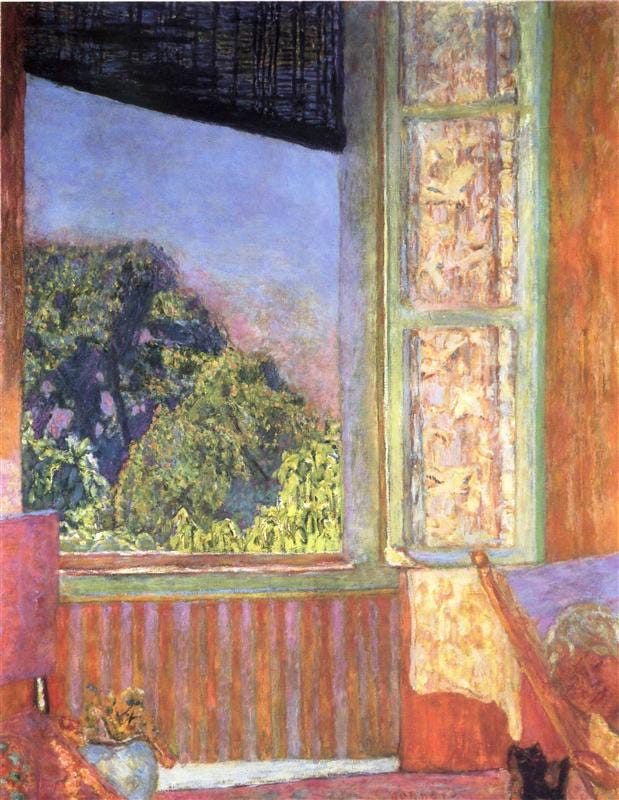
I want us to stop trying to be the last word on ourselves. Let things in—music, surprise, other people, the unearned beauty of an evening sky, the absurd specificity of being alive in this particular body in this particular place. Remember that we are not the sealed source of our own meaning. We are the ones being fed.
The whole machinery of modern adulthood works against this. We have made the inner life into another arena for performance. The porous self cannot live there. It needs fresher air.
So, as we get ready for our Joyful Anywhere summer, I think it should probably begin with the kind of self that can be surprised.
Rowan gave us a gave us a wonderful place to start. Toward the end of our conversation, I asked him directly: how do we cultivate openness to joy? How do we be open people? And he answered. The answer is good. The answer is, I think, the doorway into the whole summer.
I don’t want to give it away here, because I want you to hear him say it. So here is your first invitation:
Go listen to the conversation. On Apple or Spotify or watch on YouTube or find it anywhere you get your podcasts. Find the moment near the end where I ask him how we stay open to joy. Sit with what he says.
Then—and this is the actual practice—try it for five minutes.
Not fifty. Not an hour. Five minutes. Once this week. Somewhere you can sit or walk or stand without your phone. Let the open air find you. Notice what it feels like to not be generating anything. Notice the precise color of the sky. Notice whether your shoulders drop. Notice whether anything reaches you.
And then—and I really mean this—write me back and tell me how it went. Leave a comment. Tell me where you were, what you noticed, whether it was harder than you thought, whether it surprised you, whether you fell asleep. I am doing this too. I want to compare notes. The porous self is not a solo project. (Nothing about it is a project at all.)
Blessed are the porous!
I was reading too swiftly and read "the buffered self" as "the buttered self." I was torn for a moment because the buttered self doesn't sound too bad.
Joy, it wanders like a mist,
not for you to seek or find,
and not for you to resist
as it seeps into your mind.
It will settle there and wait
like a quiet curling cat
with its soft meows the bait
to make you say to self, "What's THAT?",
and then will come recognition,
and familiarity
from its colour and position
that it came, yes, "Just for ME!"
with its blinking amber eyes
that are both known, and surprise.